Strong vs Weak Acids: Complete Guide to Acid Chemistry
What Makes an Acid Strong or Weak?
Acids are substances that donate protons (H+ ions) or accept electron pairs in chemical reactions. The key distinction between strong and weak acids is in how completely they dissociate in water. When you drop an acid into water, it can either completely break apart into ions or only partially separate – and this behavior determines whether it's classified as strong or weak.
I remember my first chemistry lab experiment with acids. The professor warned us about handling hydrochloric acid with extreme care, while being much more relaxed about acetic acid (vinegar). At the time, I didn't fully appreciate why one required such caution while the other didn't. Now I understand it's all about their dissociation behavior and the concentration of hydrogen ions they produce.
Strong acids completely dissociate in aqueous solutions, releasing all their hydrogen ions. This means that if you dissolve a strong acid like hydrochloric acid (HCl) in water, virtually 100% of the acid molecules will break apart into H+ and Cl- ions. This complete ionization results in a high concentration of hydrogen ions, which creates a highly acidic solution with a very low pH, typically around 1-2 depending on concentration.
On the other hand, weak acids only partially dissociate in water. When you dissolve a weak acid like acetic acid (CH₃COOH) in water, only a small percentage of the molecules will break apart into ions at any given time. The majority remain as intact molecules. This limited ionization produces fewer hydrogen ions, resulting in a less acidic solution with a higher pH, usually around 3-5.
The Science Behind Acid Strength
What causes some acids to be strong while others are weak? The answer lies in molecular structure and bond characteristics. The strength of an acid depends primarily on two factors: the polarity of the bond between the hydrogen atom and the rest of the molecule, and the stability of the resulting anion after the hydrogen ion is removed.
In strong acids, the bond holding the hydrogen ion (H+) is highly polar, making it easier for the hydrogen to separate in water. Additionally, the anion that remains after the hydrogen detaches is relatively stable. For example, in hydrochloric acid (HCl), the H-Cl bond is quite polar due to the high electronegativity of chlorine, and the chloride ion (Cl-) that forms after dissociation is stable.
Weak acids, however, have less polar bonds or produce less stable anions when they dissociate. Acetic acid (CH₃COOH), for example, has a less polar O-H bond compared to strong acids, and the acetate ion (CH₃COO-) that forms after dissociation is less stable than the anions of strong acids.
The acid dissociation constant (Ka) numerically represents this tendency to dissociate. Strong acids have large Ka values (typically greater than 1), while weak acids have small Ka values (typically less than 1). This constant is often expressed as pKa (-log Ka), with strong acids having low pKa values and weak acids having higher pKa values.
Common Examples of Strong and Weak Acids
Understanding which common substances are strong or weak acids can help us better comprehend their behavior and handle them appropriately in both laboratory and household settings.
Strong Acids
- Hydrochloric acid (HCl) - Found in gastric acid in our stomachs and used in many industrial processes
- Nitric acid (HNO₃) - Used in fertilizer production and metal etching
- Sulfuric acid (H₂SO₄) - Used in car batteries and industrial manufacturing
- Hydrobromic acid (HBr) - Used in pharmaceutical synthesis
- Hydroiodic acid (HI) - Used in organic chemistry reactions
- Perchloric acid (HClO₄) - Used in analytical chemistry
- Chloric acid (HClO₃) - Used in manufacturing explosives and bleaches
Weak Acids
- Acetic acid (CH₃COOH) - Found in vinegar
- Formic acid (HCOOH) - Found in ant stings
- Citric acid (C₆H₈O₇) - Found in citrus fruits
- Carbonic acid (H₂CO₃) - Found in carbonated beverages
- Phosphoric acid (H₃PO₄) - Used in food additives and soft drinks
- Hydrofluoric acid (HF) - Used in etching glass
- Benzoic acid (C₆H₅COOH) - Used as a food preservative
I once spilled some vinegar on my kitchen counter next to a limestone decoration. The vinegar, containing acetic acid, reacted slowly with the calcium carbonate in the limestone, creating small bubbles. This gentle reaction highlighted the weak nature of acetic acid. Had it been a strong acid like hydrochloric acid, the reaction would have been much more vigorous and potentially dangerous!
Detailed Comparison: Strong Acids vs Weak Acids
Let's take a deeper look at how strong acids and weak acids compare across various properties and behaviors:
| Property | Strong Acids | Weak Acids |
|---|---|---|
| Dissociation in Water | Complete (100%) | Partial (typically 1-5%) |
| pH Range (1M solution) | 0-1 | 2-6 |
| Acid Dissociation Constant (Ka) | Large (>1) | Small (<1) |
| Reaction Speed | Fast, often vigorous | Slower, more controlled |
| Electrical Conductivity | High (many ions) | Lower (fewer ions) |
| Reaction Equilibrium | One-way reaction (→) | Equilibrium reaction (⇌) |
| Handling Safety | Requires extreme caution | Generally safer (but still acids) |
| Common Applications | Industrial processes, laboratory reagents | Food products, household cleaners, biological systems |
Acid Dissociation: The Chemical Process Explained
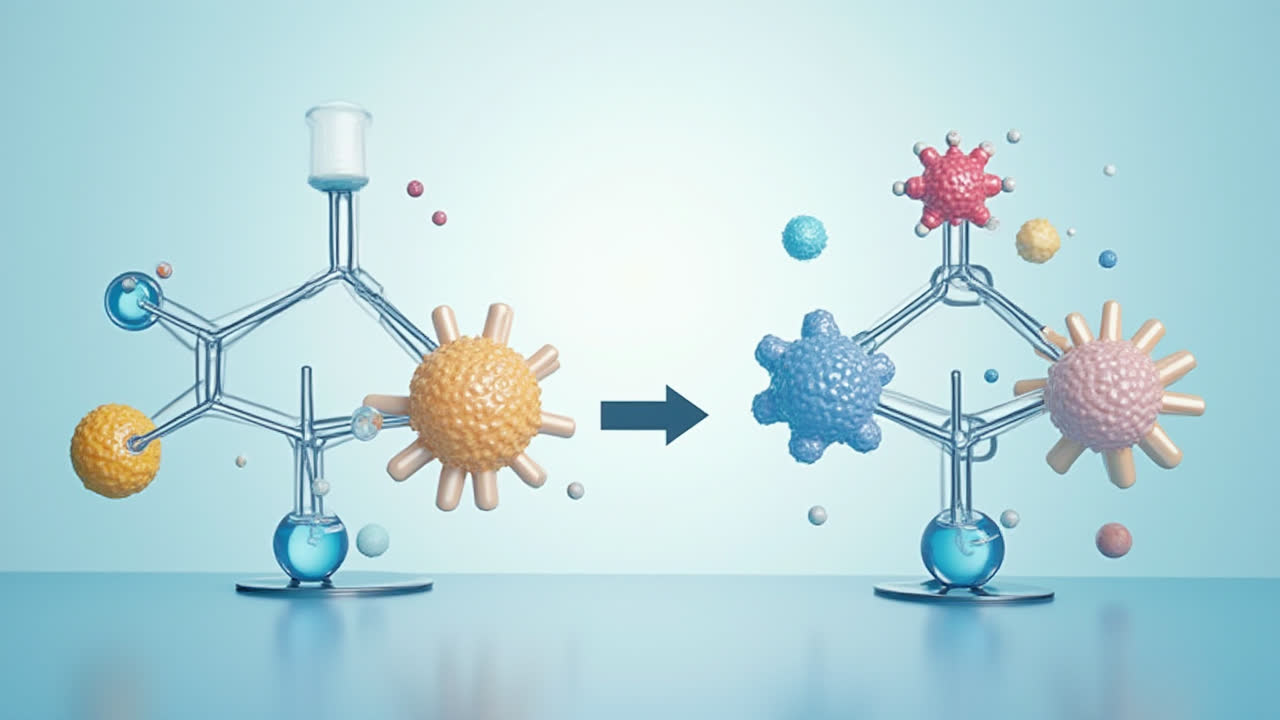
The dissociation process is fundamental to understanding acid behavior. When an acid dissolves in water, it undergoes a process called dissociation or ionization, where it breaks apart into ions.
For a strong acid like hydrochloric acid (HCl), the dissociation equation can be written as:
HCl(aq) + H₂O(l) → H₃O⁺(aq) + Cl⁻(aq)
Notice the single arrow (→) indicating that the reaction proceeds completely in one direction. Virtually all HCl molecules separate into ions, and the reaction doesn't reach an equilibrium with a significant amount of undissociated HCl molecules.
For a weak acid like acetic acid (CH₃COOH), the dissociation equation is written with double arrows to indicate equilibrium:
CH₃COOH(aq) + H₂O(l) ⇌ H₃O⁺(aq) + CH₃COO⁻(aq)
The double arrows (⇌) show that this is an equilibrium reaction. At any given time, only a small percentage of the acetic acid molecules are dissociated into ions, while most remain as intact molecules. This equilibrium is characterized by the acid dissociation constant (Ka).
The acid dissociation constant is calculated using the concentrations of products and reactants at equilibrium:
Ka = [H₃O⁺][A⁻] / [HA]
Where [H₃O⁺] is the concentration of hydronium ions, [A⁻] is the concentration of the conjugate base, and [HA] is the concentration of the undissociated acid.
Practical Applications and Implications
The distinction between strong and weak acids has significant practical implications in various fields:
In Chemistry and Laboratory Settings
Strong acids are often used in reactions where complete dissociation is desired, such as in titrations or where strong acidic conditions are needed. Weak acids are preferred in buffer solutions, where pH stability is important, as they can resist changes in pH through their equilibrium behavior.
In Industry
Strong acids like sulfuric acid are used in metal processing, petroleum refining, and fertilizer production. Weak acids find applications in food preservation, pharmaceuticals, and cleaning products where milder acidity is beneficial.
In Biology and Medicine
Our bodies contain both strong and weak acids serving different functions. Hydrochloric acid in the stomach (a strong acid) helps break down food and kill pathogens. Weak acids like carbonic acid play crucial roles in maintaining pH balance in blood through the bicarbonate buffer system.
I've noticed that many over-the-counter medications contain weak acids like acetylsalicylic acid (aspirin) or ascorbic acid (vitamin C). These compounds are designed to be stable in tablet form but can release their active components under the right conditions in our bodies. The controlled dissociation of these weak acids is key to their effectiveness and safety as medications.
Frequently Asked Questions About Strong and Weak Acids
How can you determine if an acid is strong or weak without memorizing lists?
You can determine if an acid is strong or weak by looking at its molecular structure and chemical behavior. Strong acids typically have highly electronegative atoms (like Cl, Br, I) bonded to hydrogen, forming highly polar bonds that easily break in water. Another approach is to measure its conductivity in solution—strong acids create more ions and thus conduct electricity better. You can also measure the pH of solutions of equal concentration; strong acids will produce much lower pH values than weak acids at the same concentration.
Can a weak acid ever be more dangerous than a strong acid?
Yes, in certain situations, weak acids can be more dangerous than strong acids despite their incomplete dissociation. Hydrofluoric acid (HF) is technically a weak acid but is extremely dangerous because it can penetrate skin and cause deep tissue damage and calcium depletion. Additionally, some weak acids have unique properties that make them hazardous in specific contexts. The danger of an acid depends not only on its strength but also on its concentration, reactivity with specific materials, and ability to cause harm through mechanisms beyond just its acidity.
Why do soft drinks containing weak acids not harm our digestive system?
Soft drinks typically contain weak acids like phosphoric acid or citric acid at low concentrations, which don't harm our digestive system for several reasons. First, these weak acids only partially dissociate, producing relatively few hydrogen ions compared to strong acids. Second, our digestive system has built-in protections including mucus linings and bicarbonate secretions that neutralize acids. Third, our stomach naturally contains hydrochloric acid (a strong acid) at a much lower pH than soft drinks, so our digestive tract is designed to handle acidity. However, frequent consumption of acidic beverages can potentially contribute to dental erosion over time as teeth don't have the same protective mechanisms.
Understanding Acid Strength in Context
The distinction between strong and weak acids is more than just an academic classification—it has real implications for how we use and interact with acidic substances in our daily lives and in various industries. Strong acids completely dissociate in water, producing high concentrations of hydrogen ions and very low pH values. Weak acids only partially dissociate, resulting in fewer hydrogen ions and higher pH values.
This fundamental difference affects everything from how they react with other substances to how safely they can be handled. By understanding these differences, we can better appreciate the roles that various acids play in chemistry, biology, industry, and even in our kitchens.
Whether you're a student studying chemistry, a professional working with acidic substances, or simply someone curious about the science behind everyday products, understanding the difference between strong and weak acids provides valuable insights into the behavior of these important chemical compounds.