Fiddle vs Violin: The Complete Guide to Their Differences
Fiddle vs Violin: The Complete Guide to Their Differences
As someone who's spent years performing at community festivals and formal concerts, I've often fielded the question: what's the real difference between fiddle and violin? Here's the fascinating truth – they're essentially the same instrument! Yet, ask any musician, and they'll tell you there are important distinctions that go beyond the physical. Let me break it down for you based on my experience in both classical and folk music circles.
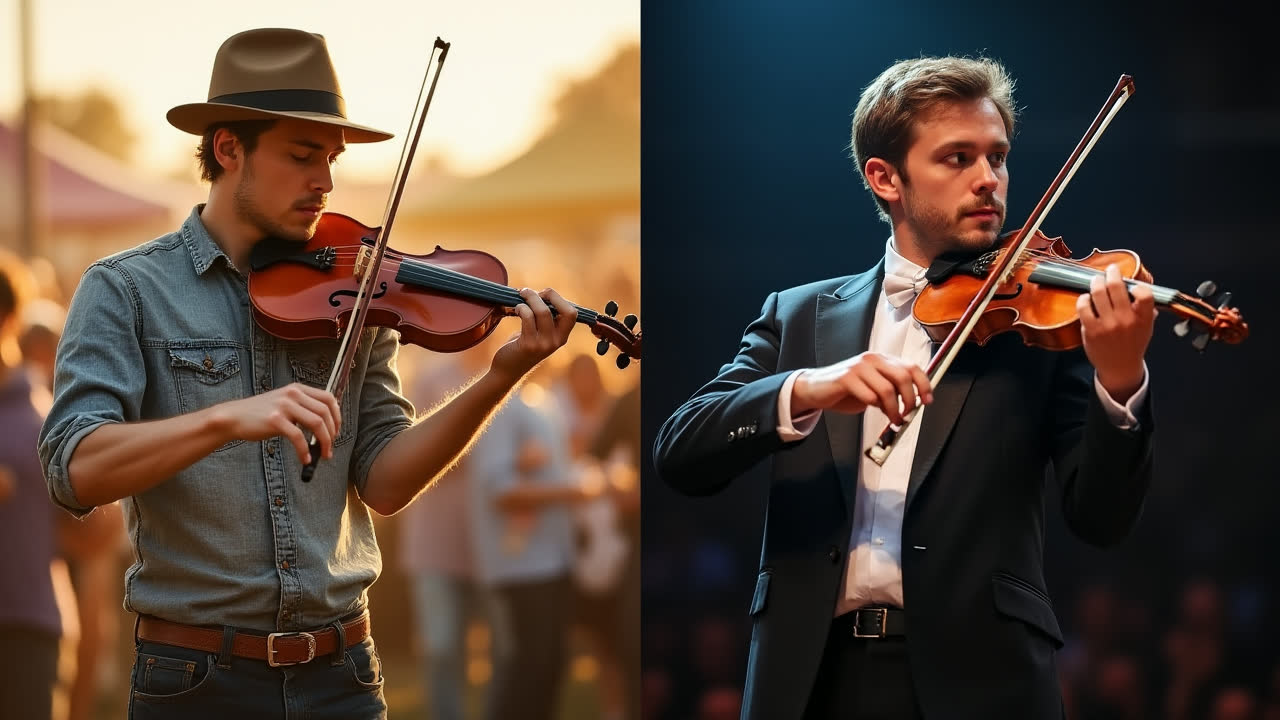
Picture this: last weekend, I found myself playing the same instrument at a classical recital in the afternoon and then at a folk jam session that evening. The instrument didn't change, but everything else – the style, the feel, the crowd – was completely different. This speaks to the heart of what makes the fiddle and violin unique despite being the same physical instrument.
What Exactly Is a Fiddle?
In my early days of learning, I remember being confused when fellow musicians would talk about "fiddling" around with tunes. It turned out they weren't just being casual with their language – they were describing a whole different approach to playing. A fiddle, technically speaking, is any bowed string instrument played in traditional or folk music styles.
The term "fiddle" has been around for centuries, and it's more than just a colloquial name. When I play my fiddle (yes, the same instrument I call a violin in other contexts), I'm often playing by ear rather than reading sheet music. The music feels more alive, more spontaneous. There's room for embellishment and personal interpretation that you don't always find in classical violin music.
Here's what makes fiddling special in my experience:
- Steel strings for that bright, energetic sound
- A slightly flatter bridge (sometimes) for quick string crossings
- Playing techniques that emphasize rhythm over tone
- Lots of double-stops and open-string drones
The best part about fiddling? You don't need years of conservatory training to start making music. I've seen complete beginners pick up a fiddle at a folk festival and contribute to the music within hours. That's the beauty of this tradition.
Understanding the Violin's Classical Heritage
When I switch to my "violin mode," everything changes. The violin carries centuries of classical tradition on its four strings. This incredible instrument, developed in 16th-century Italy, has shaped Western music in ways that still influence us today.
I still remember my first orchestra rehearsal – the precision required was intense. Unlike fiddling, where you can improvise freely, classical violin demands adherence to the composer's exact notation. Every dynamic marking, every slur, every nuanced phrase must be interpreted correctly.
The technical aspects are fascinating too. Classical violins typically have:
- Synthetic or gut strings for richer tones
- A curved bridge for precise string separation
- Fine tuners for adjusting pitch with accuracy
- Sophisticated bowing techniques like spiccato and legato
What strikes me most about the violin is its versatility. From Paganini's virtuosic caprices to Dvorak's melodic lines, the instrument can express the full range of human emotion. It's why I spend hours practicing scales and etudes – the technique demands nothing less than perfection.
Fiddle vs Violin: Key Differences Explained
| Aspect | Fiddle | Violin |
|---|---|---|
| Musical Style | Folk, country, bluegrass, traditional | Classical, orchestral, chamber music |
| Learning Method | By ear, traditional teaching | Sheet music, formal instruction |
| String Preference | Steel strings for bright tone | Synthetic or gut strings for warm tone |
| Bridge Shape | Often flatter for easier string crossing | More curved for string separation |
| Playing Technique | Rhythmic, improvised, dance-focused | Precise, composed, expressive |
| Tuning Variations | Alternative tunings common | Standard GDAE tuning |
| Performance Setting | Informal gatherings, dance halls | Concert halls, formal venues |
| Musical Notation | Minimal or none required | Extensive use of sheet music |
The Musical Context: Where Each Excels
Having performed in both settings, I can tell you that each context brings out different qualities of the instrument. When I'm fiddling at a barn dance, I'm focused on keeping people moving. The music needs to be infectious, rhythmic, and engaging. My fingers fly across the strings, and precision takes a back seat to energy.
In a concert hall, playing violin repertoire, the atmosphere is completely different. Every note must be carefully placed, every phrase shaped with intention. The audience isn't dancing – they're listening intently to the nuances of Bach's fugues or Vivaldi's concertos.
Here's something interesting I've noticed: fiddle music tends to have more repetitive patterns that make it easy to remember and play along with. Violin music, on the other hand, often has more complex harmonic progressions and intricate melodies that challenge the player technically and musically.
Physical Modifications and Setup Differences
While the basic instrument remains the same, fiddlers and violinists often make specific adjustments. I've modified my own instruments based on the playing I expect to do. For fiddle gigs, I might use a flatter bridge and steel strings. For classical performances, I switch to high-quality synthetic strings and adjust the bridge for optimal individual string clarity.
Some fiddlers even request their luthiers to set up their instruments with lower action (string height) to facilitate faster playing. This can make the instrument buzz a bit when played loudly, but that's actually considered part of the fiddle's character in some traditions!
I once had a violin maker explain to me that many fiddlers prefer maple back and sides for brighter sound projection, while classical players might prefer spruce tops for deeper resonance. These subtle preferences reflect how the playing style influences even the most basic aspects of instrument construction.
Cultural and Regional Influence
The fiddle versus violin distinction often reflects cultural identity. In Ireland, the fiddle is central to traditional music and social gatherings. Scottish fiddling has its own distinct style with quick ornaments and drone strings. American oldtime and bluegrass fiddling emphasize different techniques again.
I've been fortunate to study with musicians from various traditions, and each brings unique insights. A Cape Breton fiddler taught me how to use the "scotch snap" rhythm, while a classical violinist from Russia showed me how to achieve that distinctive Russian vibrato.
What fascinates me is how these regional differences persist even as the world becomes more connected. Each tradition serves a different community need – from dance accompaniment to concert entertainment to cultural preservation.
Learning Pathways: Two Different Journeys
My journey learning both styles has taught me that they require different mindsets. Learning violin often means years of disciplined practice, working through method books, and developing sight-reading skills. It's a structured path with clear milestones.
Fiddle learning, in my experience, is more organic. You might start with simple tunes, learn ornamentation gradually, and develop your ear through jam sessions. There's less emphasis on perfect technique and more on musical expression and community participation.
I've noticed that many fiddlers today do have classical training, which gives them a technical foundation. However, it's less common to see classically trained violinists successfully transition to fiddle styles. The rhythmic feel and improvisational aspects can be challenging for those used to reading every note.
Making Your Choice: Which Is Right for You?
So, should you pick up a fiddle or a violin? The answer depends on what type of music speaks to your soul. If you love the energy of folk music, enjoy improvisation, and want to be part of a musical community quickly, start with fiddling. The immediate gratification is wonderful – you can be playing tunes with others within weeks or months.
If you're drawn to the sophisticated harmonies of classical music, enjoy technical challenges, and appreciate the precision of orchestral performance, classical violin might be your path. Just be prepared for a longer journey before you're performance-ready.
Honestly, I'd recommend exploring both if possible. Each style enriches your understanding of the other. My classical training gives me technical facility that enhances my fiddling, while my fiddle experience has made me a more rhythmically precise classical player.
Frequently Asked Questions About Fiddle vs Violin
Is there a difference between a fiddle and a violin?
No, fiddle and violin are the same instrument. The difference lies in how they're played, the music they play, and the cultural context. Fiddles are typically used for folk, country, and traditional music with emphasis on rhythm and improvisation, while violins are associated with classical music and formal training.
Can I use the same instrument for both fiddle and violin music?
Absolutely! The same instrument can be used for both styles. Many musicians use different string types or bridge setups for optimal performance in each style, but it's not necessary. You can switch between styles using the same instrument with minor adjustments to your playing technique.
What's easier to learn: fiddle or violin?
Fiddle is generally considered easier to start with because you can begin playing simple tunes quickly without reading music. The focus on rhythm and basic technique allows faster progress in making music with others. Classical violin requires more foundational technique and music reading skills before reaching performance level.