Elements, Molecules and Compounds: Understanding the Key Differences
Chemistry is built upon understanding the fundamental building blocks of matter. The terms element, molecule, and compound are essential concepts that form the foundation of chemical science. While these terms are often used interchangeably in casual conversation, they represent distinct chemical entities with unique properties and behaviors. Have you ever wondered what makes water different from hydrogen gas, or why table salt has properties unlike either sodium or chlorine?
In this comprehensive guide, we'll explore the fundamental differences between elements, molecules, and compounds. We'll break down their definitions, explore their unique characteristics, and examine how they relate to each other in the fascinating world of chemistry. Whether you're a student, educator, or simply curious about the building blocks of our physical world, this article will enhance your understanding of these crucial chemical concepts.
What is an Element? The Basic Building Block
An element is a substance that cannot be broken down into simpler substances through chemical reactions. It represents the most fundamental form of matter that maintains its chemical identity. Each element is uniquely defined by its atomic number – the number of protons in its nucleus. This property is what distinguishes one element from another. Change the number of protons, and you change the element entirely.
The periodic table organizes all known elements based on their atomic numbers and electron configurations. Currently, scientists have discovered or created 118 elements, with 94 occurring naturally on Earth. Elements range from the lightest (hydrogen) to the heaviest (oganesson), each with its own distinct set of physical and chemical properties.
Elements can exist in different forms known as isotopes. Isotopes of an element have the same number of protons but different numbers of neutrons, resulting in different mass numbers. For example, hydrogen has three naturally occurring isotopes: protium (one proton, no neutrons), deuterium (one proton, one neutron), and tritium (one proton, two neutrons). Despite these differences in neutron count, all three are still hydrogen because they all contain exactly one proton.
When it comes to reactivity, elements display a wide spectrum of behaviors. Some elements, like the noble gases (helium, neon, argon), are extremely stable and rarely react with other elements. This stability comes from their complete electron shells. In contrast, elements like the alkali metals (sodium, potassium) are highly reactive because they have a single electron in their outermost shell, which they readily give up to achieve a more stable configuration.
What are Molecules? Atoms Bonded Together
A molecule is formed when two or more atoms bond together through chemical bonds. These bonds can be covalent (sharing electrons) or ionic (electrostatic attraction). What makes molecules fascinating is that they can display properties entirely different from their constituent atoms. For instance, sodium is a highly reactive metal that explodes in water, and chlorine is a toxic gas – yet when combined, they form sodium chloride, or common table salt, which is essential for life.
Molecules can be classified in several ways. Based on the types of atoms present, they can be:
- Homonuclear molecules: Composed of atoms of the same element (e.g., O₂, N₂)
- Heteronuclear molecules: Composed of atoms of different elements (e.g., H₂O, CO₂)
Based on the number of atoms, molecules can be categorized as:
- Diatomic molecules: Containing two atoms (e.g., H₂, O₂)
- Triatomic molecules: Containing three atoms (e.g., H₂O, CO₂)
- Polyatomic molecules: Containing more than three atoms (e.g., CH₄, C₆H₁₂O₆)
The composition and arrangement of atoms in a molecule are represented by its chemical formula. For example, the chemical formula for water is H₂O, indicating that each water molecule consists of two hydrogen atoms and one oxygen atom. The empirical formula gives the simplest whole-number ratio of atoms, while the molecular formula gives the actual number of atoms in a molecule. For propene (C₃H₆), the molecular formula shows three carbon atoms and six hydrogen atoms, while its empirical formula is CH₂.
Molecular geometry plays a crucial role in determining a molecule's properties. The shape of a molecule influences everything from its reactivity to its physical properties like boiling point and solubility. For instance, the linear geometry of carbon dioxide (CO₂) makes it a symmetrical molecule, while the bent structure of water (H₂O) creates a polar molecule with unique solvent properties.
What are Compounds? Different Elements United
A compound is a specific type of molecule formed when two or more different elements combine through chemical bonds. This is a key distinction: all compounds are molecules, but not all molecules are compounds. For instance, molecular oxygen (O₂) is a molecule but not a compound because it consists of only one element. Water (H₂O), on the other hand, is both a molecule and a compound because it contains two different elements – hydrogen and oxygen.
Compounds can form through various types of chemical bonding:
- Covalent compounds: Formed when atoms share electrons (e.g., water, carbon dioxide)
- Ionic compounds: Formed through electrostatic attraction between oppositely charged ions (e.g., sodium chloride, calcium carbonate)
- Metallic compounds: Formed when metal atoms share delocalized electrons (e.g., brass, bronze)
One of the most fascinating aspects of compounds is that they often have properties completely different from those of their constituent elements. For example, sodium is a soft, highly reactive metal that can explode in water, and chlorine is a toxic, greenish-yellow gas. However, when they combine to form sodium chloride (table salt), the result is a white, crystalline solid that's essential for human nutrition.
Compounds can be classified as organic or inorganic. Organic compounds primarily contain carbon and hydrogen atoms, often with oxygen, nitrogen, sulfur, or other elements. These include carbohydrates, proteins, lipids, and nucleic acids – the building blocks of life. Inorganic compounds typically lack carbon-hydrogen bonds and include substances like water, carbon dioxide, and various minerals.
Comparing Elements, Molecules, and Compounds
| Characteristic | Elements | Molecules | Compounds |
|---|---|---|---|
| Definition | Substance that cannot be broken down by chemical means | Group of two or more atoms chemically bonded together | Substance formed when two or more different elements chemically bond |
| Composition | Contains atoms of only one type | Contains atoms of same or different elements | Must contain atoms of different elements |
| Chemical Bonding | No chemical bonds between atoms (in elemental form) | Contains covalent or ionic bonds | Contains covalent, ionic, or metallic bonds |
| Examples | Oxygen (O), Hydrogen (H), Gold (Au) | Oxygen gas (O₂), Ozone (O₃), Water (H₂O) | Water (H₂O), Table salt (NaCl), Carbon dioxide (CO₂) |
| Unique Property | Defined by atomic number | Can be homonuclear or heteronuclear | Always heteronuclear |
| Chemical Notation | Represented by chemical symbols (e.g., H, O, Fe) | Represented by molecular formulas (e.g., O₂, H₂O) | Represented by chemical formulas (e.g., NaCl, CaCO₃) |
| Decomposition | Cannot be decomposed by chemical means | Can be decomposed into constituent atoms | Can be decomposed into constituent elements |
| Properties vs. Components | Properties define the element | Properties may differ from constituent atoms | Properties usually differ dramatically from constituent elements |
The Relationship Between Elements, Molecules, and Compounds
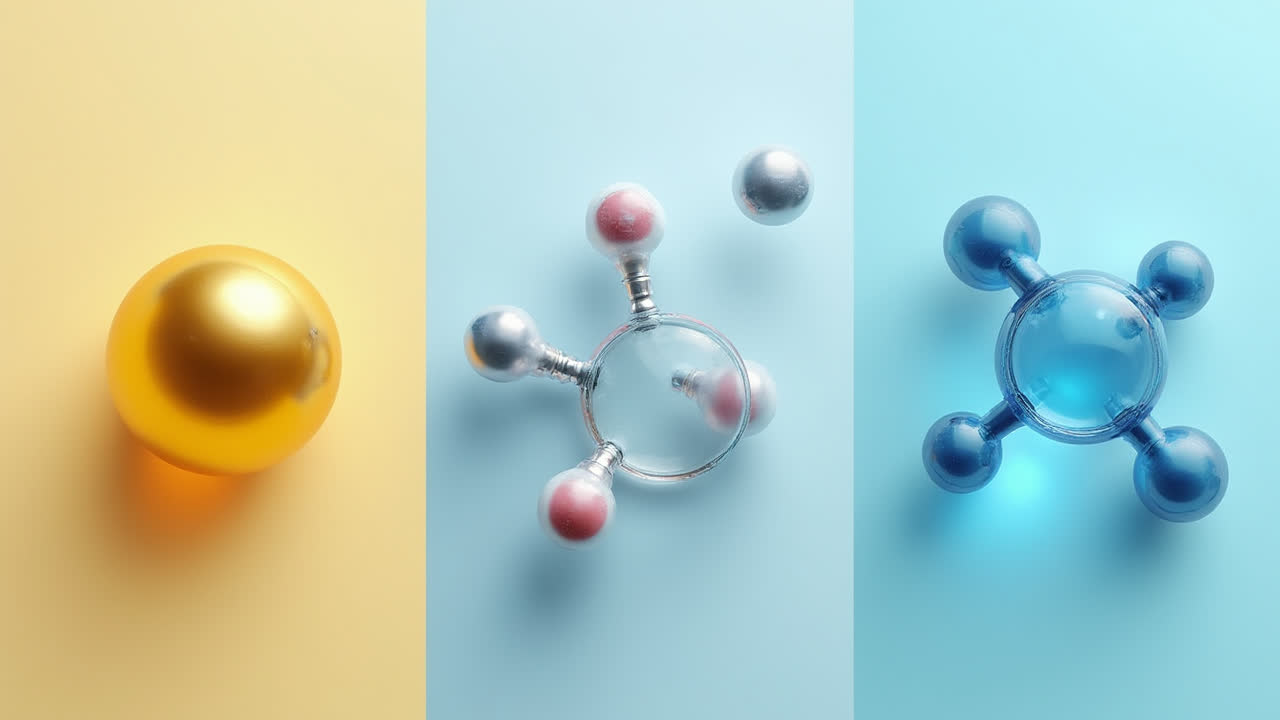
Understanding the relationship between elements, molecules, and compounds helps clarify how matter is organized in our universe. Elements serve as the foundational building blocks, molecules represent atoms joined through chemical bonds, and compounds are specialized molecules containing different types of elements.
Here's a helpful way to visualize their relationship:
- Elements are like letters of the alphabet (e.g., H, O, C)
- Molecules are like words that can be formed using those letters (e.g., O₂, H₂)
- Compounds are specifically words that use different letters (e.g., H₂O, CO₂)
In this analogy, just as different arrangements of letters create words with different meanings, different arrangements of atoms create molecules with different properties. And just as some words use only one type of letter (like "aaa"), some molecules contain only one type of element. However, most interesting words use different letters, just as compounds use different elements to create substances with unique properties.
This hierarchical relationship also extends to how we can break down matter. Elements cannot be broken down further by chemical means. Molecules can be broken down into their constituent atoms, which may be of the same or different elements. Compounds, being molecules made of different elements, can always be broken down into simpler substances - ultimately into their constituent elements.
Practical Importance in Chemistry and Daily Life
The distinction between elements, molecules, and compounds is more than an academic exercise – it has profound implications for chemistry, industry, medicine, and our daily lives. When chemists develop new medicines, they're often creating specific compounds with molecular structures designed to interact with biological systems in particular ways. Understanding the fundamental properties of elements allows engineers to select the right materials for everything from buildings to electronics. Even cooking involves chemical transformations of compounds through heat and mixing!
In environmental science, tracking the movement of elements through ecosystems helps scientists understand pollution, nutrient cycling, and climate change. Carbon, for instance, cycles through the environment as part of various compounds – from carbon dioxide in the atmosphere to glucose in plants to calcium carbonate in seashells. Understanding this element's behavior in different molecular forms is crucial for addressing environmental challenges.
Medical treatments often target specific molecules in the body. Insulin, for example, is a complex molecule that diabetic patients may need to supplement. Many medications work by binding to specific molecular structures in cells, either blocking or enhancing their function. Without a clear understanding of molecular structures and the compounds they form, modern medicine would be impossible.
Frequently Asked Questions
Can an element exist as a molecule?
Yes, elements can exist as molecules, but not all elements naturally do. Many elements, particularly gases, exist as diatomic molecules in their standard state. Examples include hydrogen (H₂), oxygen (O₂), nitrogen (N₂), and the halogens like chlorine (Cl₂) and fluorine (F₂). These are called homonuclear molecules because they consist of the same type of atom. However, noble gases like helium and neon exist as individual atoms, not molecules. While elemental molecules consist of atoms of the same element, they are not considered compounds because compounds require different elements to be bonded together.
What is the difference between a mixture and a compound?
The primary difference between a mixture and a compound lies in their composition and properties. A compound is formed when different elements combine chemically in fixed ratios, creating a new substance with properties distinct from its constituent elements. For example, water (H₂O) is a compound with properties unlike hydrogen or oxygen. In contrast, a mixture consists of two or more substances physically combined but not chemically bonded, retaining their individual properties. The components in a mixture can be present in variable proportions and can be separated by physical means. For instance, salt dissolved in water is a mixture because the salt can be recovered by evaporation, and the ratio of salt to water can vary.
How do isotopes affect an element's properties?
Isotopes of an element have the same number of protons but different numbers of neutrons, resulting in different atomic masses. While isotopes maintain the same chemical identity (they're the same element), they can exhibit slight differences in physical properties due to their mass differences. These differences can affect properties like density, melting point, boiling point, and reaction rates. In some cases, isotopes may have different nuclear stability, with some being radioactive while others are stable. For example, carbon-12 is stable, while carbon-14 is radioactive and used in carbon dating. In biological systems, the different masses of isotopes can lead to subtle effects in reaction rates, which scientists use in isotope tracing experiments to follow elements through biological pathways.
Conclusion: The Building Blocks of Our Chemical World
The distinctions between elements, molecules, and compounds form the foundation of chemistry and help us understand the material world around us. Elements are the fundamental building blocks that cannot be broken down further by chemical means. Molecules form when atoms bond together, and compounds are specifically molecules that contain different types of elements.
This hierarchical organization of matter explains both the incredible diversity of substances in our world and the underlying order that makes chemistry a predictable science. By understanding these basic concepts, we gain insight into everything from why water boils at 100°C to how medications interact with our bodies.
The next time you encounter a substance – whether it's the oxygen you breathe, the water you drink, or the complex medications you might take – you can appreciate it from a deeper perspective. Is it an element, a molecule, or a compound? How do its constituent parts contribute to its overall properties? These fundamental questions continue to drive scientific discovery and technological innovation in our ever-evolving understanding of chemistry.
References:
- http://www.thoughtco.com/definition-of-element-chemistry-604452
- https://en.wikipedia.org/wiki/Chemical_element
- http://www.thoughtco.com/definition-of-compound-605842
- http://www.thoughtco.com/what-is-a-molecule-definition-examples-608506
- https://commons.wikimedia.org/w/index.php?curid=62296883
- https://commons.wikimedia.org/w/index.php?curid=3455533
- https://commons.wikimedia.org/w/index.php?curid=32573632
- https://commons.wikimedia.org/w/index.php?curid=47225413